Steven Reed Johnson
Portland, Oregon USA

Essays and Stories












Solving Community Problems: Hardware and Software Approaches
This insight came years ago when I was making a presentation about community participation to visiting Chinese land use planners. They wanted to know about Oregon's Land use system and how Portland had achieved its "green" status as a sustainable community. My topic was about restoring urban streams. One man was introduced as number two in charge of land use planning in China. The mind boggles. Portland must have looked like a Sim City toy. I was talking to them about a 24 mile long stream that drains 54 square miles. They were creating the 3 River Gorges Dam project. I was showing them pictures of bioswales, tiny ditches along side tiny parking areas where water off of pavement could be "treated" naturally before entering urban waterways. The night before my presentation I was trying to come up with ways of explaining this kind of "small is beautiful," approach to urban storm water problems. There is a long history in this tiny watershed (see URL below) of attempts to solve pollution and flooding problems. Several times large dams were planned to control the flooding and always voted down by the people. We had, by time I gave this speech, solved many of the point pollution problems. We were now at the Pogo point (We have met the enemy and he is us). The problem was not one or two industrial polluters, but to some degree all of the 175,000 residents of the watershed. We each contributed a trickle of water and a dab of pollution from what came off our roofs, sidewalks, driveways, and roads.
We could have created a filtration plant or two that could possibly solve the problem. In either case we were looking at the problem from a hardware perspective: built a filtration plant or build a dam.
There is a variation on the "free rider" riddle. The problem is viewed in us and them terms even though it is us and us. All of us were creating the problem, but we wanted a nebulous "them" (government) to solve the problem. But time and time again in this watershed proposals by the government to solve flooding and pollution problems had been nixed. Nobody wanted to pay for the solution (dams or filtration plants). With some of the early proposals (mid 1970s--mid 1980s) there was also a cart before the horse problem. The regional government, Metro (at the time called Metropolitan Services District) proposed a solution that involved creating special district that corresponded to watershed or basin boundary. But, nobody knew what a watershed was. There were people being asked to pony up to solve problem for a stream who lived miles away and may have never even seen the stream. They did not identify as residents of the "watershed."
De Tocqueville prophesized this problem 150 years ago when he observed this wild American experiment in Democracy and declared that it might work but only if people were centrally involved in solving collective problems. If not than government would get larger and larger and more bureaucratic and regulatory. He didn't use all these words, but go back to the text and see for yourself (see reference below). His prophetic analysis seems to fit our current situation. Citizens want solutions to problems to be carried out by government but are less and less willing to pay for the solutions through taxing themselves for big hardware solutions and at the same time are less inclined (See Bowling Alone) to be involved in collective solutions.
We also have governing structures geared to solving problems by designing and constructing hardware solutions. Our specialties, budgeting process, and regulations are framed in context of creating public works projects. We also have an educational system that focuses on hardware solutions, e.g., civil engineering. Whereas our need is to produce university graduates who have a different set of social and planning skills that can produce software solutions.
Consider the software perspective on solving the critical flooding and pollution problems in the watershed. I couldn't find data easily on number of businesses and number of households in the watershed. I vaguely remember there were about 60,000 businesses and 50,000 households. (*I will replace this with real numbers when I find them). To solve the problems using the software approach one has to find ways to distribute the collective contribution. In the case of businesses that might mean contacting all businesses and helping the owners re-design their parking areas, planting or replanting vegetation, reducing the number of cars driven to work, helping the businesses refinance the retro-fitting or design through tax incentives or loans. Likewise with households, to create a software solution one has to find ways to distribute the collective contribution. The City of Portland’s Bureau of Environmental did just this by creating a stormwater disconnect program. Households that disconnect from the stormwater system, thus reducing their "contribution" to the stormwater, received a reduction in their stormwater bills. The City also furnished inexpensive hoses that could be connected to the bottom of gutters so water coming off rooftops could be more evenly distributed in a yard or collected in rain barrels for future use.
In both cases the software solutions demand different governing structures, budgeting and taxation, and skill set for bureaucrats administrating the programs.
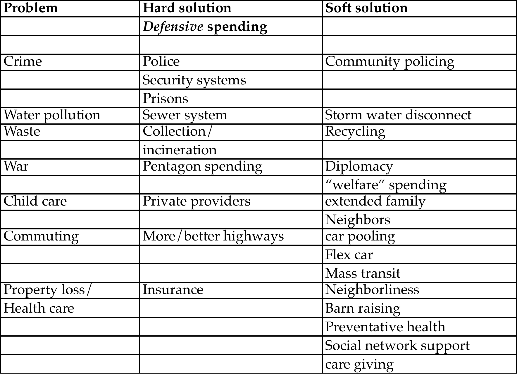
This example of creating and administrating software solutions in a small urban watershed can be applied to many other social and environment problems. The chart below illustrates software and hardware solutions, some in practice, some imagined. Two very familiar ones are waste problems and crime. Implementing recycling programs that distribute the collective cost by people sorting their own waste or contributing less to the waste stream in the first place. Or in the case of crime, community policing programs, neighborhood agreements (* see...) that facilitates crime reduction through facilitating or rebuilding social capital in a neighborhood.
The crime prevention example also illustrates another conundrum we face. We turn over a larger and larger portion of our income on defensive spending or for expenses that used to be free, or in effect were paid for through our social capital, and our social capital networks. James Coleman as early promoter if not "inventor" of social capital theory, illustrated how it worked through observations of two parks. The park that was safe allowed women to leave their children unattended but observed. The crime prevention was a social capital benefit of a neighborhood rich in social capital. In some parks that would be unthinkable, and families would have to pay the police through taxing themselves or paying for nannies or private security guards. Likewise if your home is unattended in social capital rich environment there is little cost to safeguarding it. In extended families, or families where there was only one breadwinner, someone was more often home. If not again you pay for services, e.g., police, private security or a home alarm system. Embedded in this example is also another cost, and often a very substantial one that results from lack of social capital. If in the typical household both parents work then childcare needs to be paid for.
The result of this dwindling of social capital treasuries and collective action to remedy social and environmental problems is that personal and family incomes have to continually increase to make up for the loss of social capital. But, taxpayers revolt as they try to make ends meet and are unwilling to transfer yet more of their income through taxation to support government programs that
make up for their inability or unwillingness to carry out collective actions that would reduce government expenditures.
Many of the local and global problems we face today can not be solved using a hardware perspective. Many intractable and "wicked" problems can only be solved through collective action. Our education system is designed to turn out specialists trained in solving problems in the hardware paradigm. Additionally, most university graduates, let alone the general population, do not have the skills and knowledge it takes to be an effective citizen--the topic of an up and coming mini-essay.
We are also deficient in knowledge about the places we live. By surrendering generalist knowledge about a particular place to specialists we have given up our generalist knowledge about the places we live. If we were on a survivor island TV show, where the island replicated the places we lived we would probably die. We would not know how it worked. A topic of another short essay to come.
References
Johnson creek watershed restoration history:
http://www.stevenreedjohnson.com/stevenreedjohnson/myPlace.html
Pogo comic strip:
http://en.wikipedia.org/wiki/Pogo_(comic_strip)
Democracy in America, Alex De Tocqueville, book II, chapters 27--29, 192—202
Putnam, Robert. (2000). Bowling Alone: Collapse and Revival of American Community. New York: Simon and Schuster.