Steven Reed Johnson
Portland, Oregon USA

Essays and Stories












Evaluating a Communities Civic Infrastructure
Community economic and environmental sustainability depend on a healthy civic infrastructure. The National Civic League, in their civic index project, defines this as the “formal and informal processes and networks through which communities make decisions and attempt to solve problems (National Civic League 2007).” A robust civic infrastructure is important to general community well-being, but it is especially critical to reaching sustainability goals because neither the public nor private sectors alone can accomplish long-term objectives that require vast collective action. Both sectors have essential roles to play, but unlike in the past when large public works or private enterprises could achieve improvements in social and economic life, building a sustainable future depends more on innovative collective action. Fortunately, we now have the capacity, through information technologies coupled with creative forms of social actions, to muster the “wisdom of crowds” to achieve collective, sustainable outcomes.
So, what are the characteristics of a healthy civic infrastructure? In this chapter, I share my understanding derived from thirty years as a community activist in Portland, Oregon, and ten years of scholarly research on the transformation of American civic life since World War II through the lens of Portland. Portland is an ideal model for study because of its stellar reputation in both the civic engagement and sustainability arenas.
Elements of a Healthy Civic Infrastructure
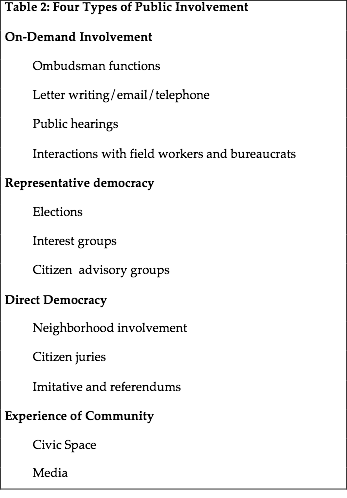
By examining Portland’s robust civic infrastructure, it is possible to delineate key characteristics that nurture a community’s healthy civic life. I have categorized civic venues into four types, (1) on demand involvement, (2), representative democracy, (3) direct Democracy, and (4) experience of community.
Most citizens encounter their local government institutions through specific actions and in a limited time framework. If there is a problem in their neighborhood or their school, or a problem with the transportation system, people want a way to address their issue immediately. They want “democracy-on-demand” services such as an Ombudsman provides; the opportunity to testify before a City Council or other civic body; and an open and accessible government to call, write, or email. To most citizens, even in a rich civic environment like Portland, this, along with the electoral process, are the means of interacting with local government. For most, perceptions of government are formed by interactions with lower level bureaucrats and field workers – the government employee in a brightly colored safety vest filling a pothole in the neighborhood, for example.
The heart of representative democracy is the electoral process, but citizens are also represented via interest groups and citizen advisory groups. Those appointed to advisory groups usually have a relatively high level of skill and knowledge about public policy, plus specialized knowledge of the issue, e.g. transportation planning, health care, etc. The commitment of these “professional” citizens is substantial. An appointment to a citizen advisory committee might last months, even years, and involve frequent meetings, a substantial commitment to learning technical information, and the willingness and ability to mediate with other stakeholders over contentious issues. This tier of civic engagement plays a vital role in the health of a community’s civic life. “Professional” citizens provide knowledge and perspectives because of their day-to-day work within interest groups or NPOs that extends the capacity of local government agencies. While these citizens often provide valuable and objective information to the local public policy debate, they may also have invested interests and be a part of the establishment in ways that your average citizen are not.
Opportunity and Efficacy
In Portland, traditional civic life declined because traditional groups either died or became irrelevant. Less than 20% of the civic groups of 1960 were still in existence in 2000. Over time, they either failed to be inclusive, adaptive, or innovative, and, at some point, no longer served as the sources of civic skills and knowledge acquisition for citizens desiring to effectively participate in the civic life of the community.
Citizens need opportunities to be involved. In Portland, the opportunities are numerous and widespread; but opportunity without continual investment in the human capital of citizens can be a formula for civic policy gridlock. If citizens have opportunity to be involved in local decision-making, planning, and public policy, but no means of acquiring the knowledge that provides a deeper context of civic values, they may only represent their own self interest, without regard for outcomes beyond their immediate neighborhood or specific issue. This can create cynicism, mistrust, and policy gridlock and may create costly impediments to public problem-solving. The public sector, in partnership with K-12 schools and universities, needs to insure the means of acquiring the skills and knowledge for effective citizenship. Showing up is necessary, but not sufficient.
Engaged schools and universities
The civic health of a community depends on an education system that nurtures good citizens as well as wage earners. It is a public good that lowers the cost of governance. One promising direction in civic education is Portland State University’s (PSU) community-based learning curriculum. Every year, 8,000 students work in the community, selecting from 1000 different community partners. At the heart of this innovative curriculum is learning, not volunteerism. While PSU students perform valuable community service – contributing $4-6 million annually in volunteer time – the university assesses outcomes as measured by decreased drop-out rates, assessment of the learning environment by students and faculty, and, in the long term, the continued involvement of students in civic life. This last measure is determined, in part, from the students’ experiences. When graduates of PSU are asked if they plan to continue their engagement, the strongest determinant is their sense of efficacy, i.e. whether what they did made a difference. This need for efficacy was tempered by the degree to which they felt trust in public institutions. If trust and efficacy were lacking, then students tend to look out only for themselves, leaving the work of protecting the commons to someone or something else (Morgan and Williams 2003).
Universities are an important incubator of innovative community problem-solving processes. PSU students played a important role in defining Portland’s neighborhood system by demanding a role in urban renewal efforts near the university. Students initiated a housing program that has grown into College Housing Northwest, a multi-million dollar housing corporation for student housing in downtown Portland. Portland’s nationally known bicycle transportation program had its birth in the PSU Bike Lobby in the early 1970s. And, the first recycling businesses in Portland were student-led: Cloudburst, Sunshine Recycling, and Portland Recycling Team.
Facilitative Leadership Style
Universities also have a key role in maintaining a healthy civic infrastructure by virtue of nurturing public servants who know how to facilitate effective citizen involvement. Today’s public servants or bureaucrats need a new suite of skills and knowledge that allow them to tap the “wisdom” of citizens. Typical graduates of universities come away with specialized knowledge, but often lack the skills and knowledge to work with citizens. An engineer may know how to build a road, but not how to work with community members to build roads that meet a multitude of livability goals citizens deem important.
Portland's civic renaissance was fueled by a symbiotic relationship between citizens and government. The leadership in Portland during the early 1970s, and at several points since then, has been more facilitative than paternalistic. What Portlanders sometimes forget is that many of the civic jewels of which they are proud (e.g. Portland’s Pioneer Square, Oregon’s Bottle Bill and public beaches) were the result of hard work by citizens facilitated by government. When asked about some of Portland’s civic innovations (see table 3) leaders, but seldom know about the key role that individual citizens and civic organizations played in the creation of those innovations.
Importance of Civic Space
Habermas (1989) linked the birth of modern liberal democracy in the 18th century to the emergence of public spaces, such as coffeehouses, clubs, salons, societies, and voluntary associations, and a press that enabled the public to serve as the bearer of public opinion. He also links the current trend to privatize public space to the diminished role of civic space. Civic spaces are an extension of the community. When they work well, they serve as a stage for our public lives. If their civic role is functional , they can be the settings where celebrations are held, where exchanges both social and economic take place, where friends run into each other, and where cultures mix. When cities and neighborhoods have thriving civic spaces, residents have a strong sense of community. When such spaces are lacking, people may feel less connected to each other. If civic spaces are inadequate, civic life, including citizen participation, will suffer. If urban design emphasizes gated communities and private or semi-private spaces over public, and does not include plentiful locales where people can mix across class or cultural boundaries, then, when citizens must come together to solve community problems, it will be much more difficult.
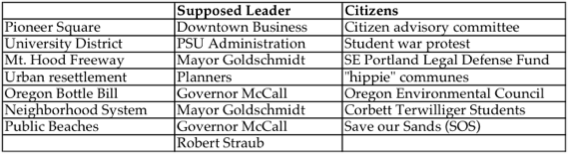
Portland Civic Projects: Leaders and Citizens

